Lambert Academic Publishing (or How Not to Publish Your Thesis)
[Updated March 2014, see update below]
Lambert Academic Publishing (LAP) is an imprint of Verlag Dr Muller (VDM), a publisher infamous for selling cobbled-together "books" made up of Wikipedia articles mainly under their Alphascript Publishing imprint. LAP, on the other hand, specialize in "publishing" academic theses [update: they also use the names Scholars' Press and Editorial Académica Española (EAE)]. Below, I summarize what's known about LAP's operations (and my opinion of "publishing" a thesis with such an organization), but consider this first:
Lambert Academic Publishing on Facebook have an Acquisition Editor called "Kevin Woodmann". This is a little curious as Kevin is not a common German name, though apparently it was popular in East Germany in the 1990s. Here's his profile:
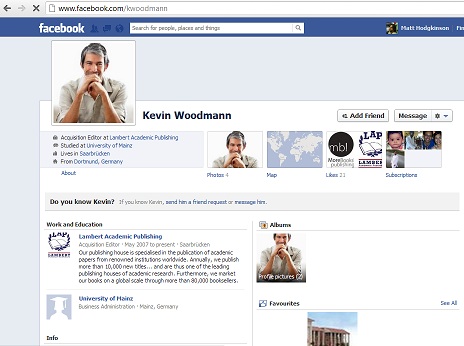
He's a handsome guy with salt-and-pepper hair; there's a touch of George Clooney to him. There's a catch though - Kevin's photo is actually a stock photo of a "Confident middle aged man sitting and smiling against white background" by Yuri Archurs:

Yasmine Watson, another Acquisition Editor, is actually a "Smiling business woman with colleagues at the back"; Sophia Campbell is a "Young business woman laughing over a thought"; Lisa Thompson is a "Happy casual business woman holding her coat over shoulder at her workplace".
And so on. Legitimate publishing businesses do not create false profiles on social media sites.
What else is known about VDM/LAP (and the many other names used by this company)?
- They find authors largely by bulk-emailing students who have recently published theses;
- They have no selectivity - anyone who submits their "book" will have it "published";
- They do not conduct peer review;
- They do not edit the "book", and they "publish" exactly what is submitted - and apparently they charge for any changes made by the author after submission;
- Authors will almost certainly never receive any royalties (a blogger notes that "I have yet to found the testimony of anybody who has received royalties");
- They do not market the "books";
- The "books" do not count in many research assessment processes.
For example, see this summary of the business practice of VDM/LAP from an Australian university:
"LAP Lambert does not conduct a peer review/editorial process. Manuscripts are published exactly as they are submitted to the publisher."
"Where royalties average less than 50 Euro a month, the author is given book vouchers for other LAP Lambert stock. An author’s share is usually always under this because at the average rate of 80 Euro a book, it means they would have to sell 11 copies a month to exceed the 50 Euro threshold, which is difficult since the company does not undertake any marketing on behalf of the author."
"This could adversely affect the opportunity to have your work accepted in a reputed peer-reviewed journal."Also see this experience of "publishing" with LAP:
"I should point out that once you’ve submitted your publication-ready document to LAP’s online system, that’s it. If you’ve made a mistake and left off one-third of your reference list (as I almost did) they impose a hefty fee for having to intervene to make corrections."
"My personal copy arrived last week. Looks just like my thesis (but with less expensive paper, a smaller font and packaged as a paperback!)"
"When I checked my author's account at Lambert Academic Publishing at the end of the last financial year (after my beautifully paperbacked master's thesis had been on sale via Amazon for 12 months) not only had no royalties accrued to me, but zero copies of the book had been sold."Is the publication of these "books" solely the responsibility of Lambert Academic Publishing and their ilk? (author mills, vanity presses, call them what you will) Are these authors all unwitting victims? I think the answer is no. Many new authors starting out on an academic career are desperate to get published, but "publishing" an unaltered thesis with a print-on-demand publisher without making clear that the "book" is a copy of the thesis is, in my opinion, an attempt to gain unearned academic credit for no additional work. I do not think that charging people $97 on Amazon to read a repackaged thesis is reasonable. I believe that many who buy these books will think that they are buying a published book and not an unedited thesis, and they will be misled and angry.
If you only want your thesis to be made available to more readers, there are many acceptable self-publishing and/or open access options. If you want to get academic credit beyond the qualification gained from publishing the thesis then there is no short cut: you need to publish with peer-reviewed journals or book publishers. See for example Resta et al. Publishing a Master’s Thesis: A Guide for Novice Authors. J Genet Couns. 2010 June; 19(3): 217–227 (free to access).
Find a reputable publisher and do not simply copy your thesis word-for-word - otherwise, don't be surprised to see your own academic reputation suffer.
---
Update, March 2014:
Lambert Academic Press continue to offer their "services" under a number of different names - Scholars' Press, Omniscriptum, GlobeEdit, the Spanish-language Editorial Académica Española (EAE) and Publicia, the Italian-language Edizioni Accademiche Italiane (EAI), the German-language Akademikerverlag, Südwestdeutscher Verlag für Hochschulschriften, and Saarbrücker Verlag für Rechtswissenschaften, the French-language Éditions Universitaires Européennes and Presses Académiques Francophones, Palmarium Academic Publishing, the Polish-language Wydawnictwo Bezkresy Wiedzy - and unwary authors continue to "publish" with them, but this blog post and others like it at least serve to warn some academics of the nature of their business. One of the latest is the delightfully titled "Please do not publish my thesis" by Eva Amsen, aka easternblot.
I was interviewed earlier this year by a journalist, Joseph Stromberg, based on this post.
"plenty of people consider the company’s strategy predatory—and in his research, Hodgkinson uncovered a curious pattern that lends credence to this"As well as interviewing me and Thorsten Ohm, the CEO of VDM, Joseph 'took one for the team' and "published" his own thesis with LAP, discovering in the process that LAP do a hard sell on their new authors to try to make them purchase copies, something I believe is a new angle on their business model.
"LAP Lambert’s real plan finally became clear: They make money not by selling arcane tomes to readers, but by selling the books back to their authors after they’ve already signed away the rights."His fascinating piece, "I Sold My Undergraduate Thesis to a Print Content Farm", was published by Slate.
p.s. I noticed that Betascript, an imprint VDM uses to sell their collections of Wikipedia articles, uses the name "Lambert M. Surhone" for one of their fake editors. Someone at VDM obviously likes the name "Lambert".


20 comments:
Thanks for the dissection! I just got an email from these guys (still trying to figure out where they got my address) and the whole thing looked so sketchy that I googled them at once; this blogpost is the second result. Honestly I can't see how this could appeal to anyone. If I padded out my lean CV by adding a book which was blatantly just my repackaged thesis, any sane employer would see it as a red flag for my honesty rather than proof of my productivity. Anyway I don't need the royalties -- a Nigerian businessman will be sending me five million dollars any day now...
Can I still retrieve my publishing rights from Lap Lambert having learnt that I was acting on an academi spam?
Here is another bogus profile of one of their reps:
https://www.facebook.com/david.daniels.520562
Hey guys! I found this blog (like other) just after have signing the agreements with them (LAP Lambert), Fortunately I don't put my thesis on their website, but I m scared about the penalisation. Someone can help me!
Thanks a lot.
Julián
I suggest that you speak to your institution (e.g. your dean or librarian) about how to cancel any agreements with them.
Thank you for this great dissection. I only wish I would have found it sooner as I had my thesis published with them. I looked them up under a different name . I think they leave the mistakes in and or create their own on purpose so folks will pay to have it edited.
I will chalk this up as a hard lesson learned and may look into canceling my agreement with them. Thank you again.
Yes, thanks for the post! After getting an email from them I googled "LAP Lambert Lisa Thompson" and found this blog. Happy I didn't reply to them!
Thank you for this warning. I was contacted on my work email, and was at first flattered since I do not have any ambitions in academics (at least not now). After this blog, I am not so flattered anymore - but at least I`m glad I did not send anything to them.
Thanks for information. I got from them a similar offer. They don't do even an elementary googling. Would they do they would see that I have already published my PhD thesis by other, respectable publishing house (both hardcover and paperback). So I answered them they if they interesting in translating and publishing my book in German given that they sitting in Germany, I would not be against it, but they should do it on their own account...
I saw this article too late and let LAP publish my thesis. Then they basically disappeared and I never even got a copy of the book. Now I see 11 used copies for sale on Amazon. Royalties?? What a joke. What a scam.
I received a similar scam mail today morning from some Sergiu Crudu, who claims to be from the editorial team of Lambert Academic Publishing. She claimed to be interested in publishing my MA thesis as a 'BOOK' for FREE !! That's a give away for knowing it is a scam. Anyone who has even tiny bit of experience in academia would know how difficult and rigorous it is to get your work rightfully and authentically published!
Seriously, A MUST AVOID COMPANY!!!!
First they convinced you to publish your thesis with them, telling you that you will be receiving royalties payment in the future and they will market your book on various online bookstore. That’s absolute crap!!
What they actually do is converting your thesis into a “book” which do not even exists. It is only print on demand and the price is about 35 to 100 EURO which I am sure nobody will be interested to buy as it is already available online on your university library I suppose.
So they make you BUY YOUR OWN WORK!!! Yes, that’s true! They will persuade by telling you that the more copies that you gonna buy, the more the price will be reduced..etc..etc. The fact is that THEY RUN THEIR BUSINESS BY MAKING YOU PURCHASING YOUR OWN BOOK. They know that nobody will buy your book. That”s the business. One book is approx 40 EUR and you need to buy minimum 3 copies!! So they earn about 120 EUR from one author :O . Just imagine how many persons do they contact in a day!
Moreover, they have several imprints such as Scholars Press and many others! THEY ARE FOOLING US.
They made me purchase my book and it has been almost 2 years and not even a single copy of my book has been sold so far. I am not the only person who has experienced this but also many colleagues of mine. Our university is now trying to prevent students to publish with them!
They have just started this model of business in Brazil too: http://editoraprismas.com.br/ Pletny of colleagues are receiving emails from them, with "invitations", that of course touch one´s ego.
I received similar mail offering to publish my research as a book. I replied and requested further details. The Acquisition Editor responded immediately. But before acting I decided to check and the name of the acquisition editor appears curiously similar to that of a professor in Australia. No profile online to indicate the background and link to Lambert.
I decided to google and these blogs come up. Thank you for saving my work. Okwiri
fooled ! :(
Hey, thanks for this! A brief moment of excitement followed by realisation that the email belongs in my spam folder! Back to normal life...
And, Bluffer Xask - buy your own thesis off them? Why on earth would you actually go through with that?
Thanks for this clarification as this blog appeared during googling on this company as l received email from them so l get doubtful about this as l know how is it very difficult to make a respectful publishing. But as their fraud is very obvious why there is no action taken against them
A comment from a reader's perspective, I purchased a very interesting book from this publisher (via net) on little known edible plants in India, I thought it was a little odd that the grammar was very poor, though thought this might be normal for Indian texts in English, a second language, all the scientific names were accurate at least. I was suspicious enough to Google the publisher, interestingly the first time I've ever done this, good to read your comments.
I get the impression the references to edible species are accurate, but many seem unique to this text so almost too good and exciting to be true, but they may well be true. It would be very sad if this is a sound document and the author was innocent of the nature of this publisher. This is certainly disappointing to me, will still use the book but with caution.
I would have thought a publisher like this could get into trouble, if a book falsely says something is edible and it kills someone who eats it couldn't they be held accountable, I suppose they've thought of ways around this.
It looks like they're still at it, I had an email offering to publish my case study/thesis from 2007 about a now defunct department based at a single retail branch of a national UK chain. I'm going to email them back and ask "who cares?"
I was excited to receive such a good news to publish my paper into a book plus royalties. So in my joy to reply them, I wanted to know how to address the editor because I wasn't familiar with the name. So I took the editor's with the publication name and googled and hold and behold, I landed here and other blogs showing how scam they are. I thank God I did not reply them.
Post a Comment