Lambert Academic Publishing (or How Not to Publish Your Thesis)
[Updated March 2014, see update below]
Lambert Academic Publishing (LAP) is an imprint of Verlag Dr Muller (VDM), a publisher infamous for selling cobbled-together "books" made up of Wikipedia articles mainly under their Alphascript Publishing imprint. LAP, on the other hand, specialize in "publishing" academic theses [update: they also use the names Scholars' Press and Editorial Académica Española (EAE)]. Below, I summarize what's known about LAP's operations (and my opinion of "publishing" a thesis with such an organization), but consider this first:
Lambert Academic Publishing on Facebook have an Acquisition Editor called "Kevin Woodmann". This is a little curious as Kevin is not a common German name, though apparently it was popular in East Germany in the 1990s. Here's his profile:
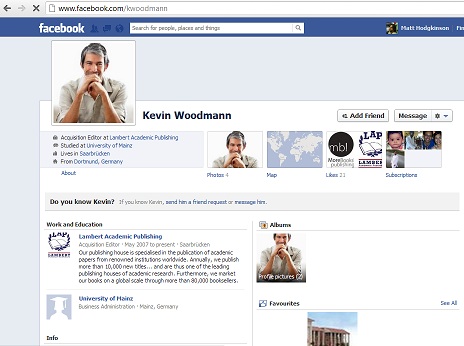
He's a handsome guy with salt-and-pepper hair; there's a touch of George Clooney to him. There's a catch though - Kevin's photo is actually a stock photo of a "Confident middle aged man sitting and smiling against white background" by Yuri Archurs:

Yasmine Watson, another Acquisition Editor, is actually a "Smiling business woman with colleagues at the back"; Sophia Campbell is a "Young business woman laughing over a thought"; Lisa Thompson is a "Happy casual business woman holding her coat over shoulder at her workplace".
And so on. Legitimate publishing businesses do not create false profiles on social media sites.
What else is known about VDM/LAP (and the many other names used by this company)?
- They find authors largely by bulk-emailing students who have recently published theses;
- They have no selectivity - anyone who submits their "book" will have it "published";
- They do not conduct peer review;
- They do not edit the "book", and they "publish" exactly what is submitted - and apparently they charge for any changes made by the author after submission;
- Authors will almost certainly never receive any royalties (a blogger notes that "I have yet to found the testimony of anybody who has received royalties");
- They do not market the "books";
- The "books" do not count in many research assessment processes.
For example, see this summary of the business practice of VDM/LAP from an Australian university:
"LAP Lambert does not conduct a peer review/editorial process. Manuscripts are published exactly as they are submitted to the publisher."
"Where royalties average less than 50 Euro a month, the author is given book vouchers for other LAP Lambert stock. An author’s share is usually always under this because at the average rate of 80 Euro a book, it means they would have to sell 11 copies a month to exceed the 50 Euro threshold, which is difficult since the company does not undertake any marketing on behalf of the author."
"This could adversely affect the opportunity to have your work accepted in a reputed peer-reviewed journal."Also see this experience of "publishing" with LAP:
"I should point out that once you’ve submitted your publication-ready document to LAP’s online system, that’s it. If you’ve made a mistake and left off one-third of your reference list (as I almost did) they impose a hefty fee for having to intervene to make corrections."
"My personal copy arrived last week. Looks just like my thesis (but with less expensive paper, a smaller font and packaged as a paperback!)"
"When I checked my author's account at Lambert Academic Publishing at the end of the last financial year (after my beautifully paperbacked master's thesis had been on sale via Amazon for 12 months) not only had no royalties accrued to me, but zero copies of the book had been sold."Is the publication of these "books" solely the responsibility of Lambert Academic Publishing and their ilk? (author mills, vanity presses, call them what you will) Are these authors all unwitting victims? I think the answer is no. Many new authors starting out on an academic career are desperate to get published, but "publishing" an unaltered thesis with a print-on-demand publisher without making clear that the "book" is a copy of the thesis is, in my opinion, an attempt to gain unearned academic credit for no additional work. I do not think that charging people $97 on Amazon to read a repackaged thesis is reasonable. I believe that many who buy these books will think that they are buying a published book and not an unedited thesis, and they will be misled and angry.
If you only want your thesis to be made available to more readers, there are many acceptable self-publishing and/or open access options. If you want to get academic credit beyond the qualification gained from publishing the thesis then there is no short cut: you need to publish with peer-reviewed journals or book publishers. See for example Resta et al. Publishing a Master’s Thesis: A Guide for Novice Authors. J Genet Couns. 2010 June; 19(3): 217–227 (free to access).
Find a reputable publisher and do not simply copy your thesis word-for-word - otherwise, don't be surprised to see your own academic reputation suffer.
---
Update, March 2014:
Lambert Academic Press continue to offer their "services" under a number of different names - Scholars' Press, Omniscriptum, GlobeEdit, the Spanish-language Editorial Académica Española (EAE) and Publicia, the Italian-language Edizioni Accademiche Italiane (EAI), the German-language Akademikerverlag, Südwestdeutscher Verlag für Hochschulschriften, and Saarbrücker Verlag für Rechtswissenschaften, the French-language Éditions Universitaires Européennes and Presses Académiques Francophones, Palmarium Academic Publishing, the Polish-language Wydawnictwo Bezkresy Wiedzy - and unwary authors continue to "publish" with them, but this blog post and others like it at least serve to warn some academics of the nature of their business. One of the latest is the delightfully titled "Please do not publish my thesis" by Eva Amsen, aka easternblot.
I was interviewed earlier this year by a journalist, Joseph Stromberg, based on this post.
"plenty of people consider the company’s strategy predatory—and in his research, Hodgkinson uncovered a curious pattern that lends credence to this"As well as interviewing me and Thorsten Ohm, the CEO of VDM, Joseph 'took one for the team' and "published" his own thesis with LAP, discovering in the process that LAP do a hard sell on their new authors to try to make them purchase copies, something I believe is a new angle on their business model.
"LAP Lambert’s real plan finally became clear: They make money not by selling arcane tomes to readers, but by selling the books back to their authors after they’ve already signed away the rights."His fascinating piece, "I Sold My Undergraduate Thesis to a Print Content Farm", was published by Slate.
p.s. I noticed that Betascript, an imprint VDM uses to sell their collections of Wikipedia articles, uses the name "Lambert M. Surhone" for one of their fake editors. Someone at VDM obviously likes the name "Lambert".


